2.11.1 Medical and dental expense – delete
2.11.1 — Medical and Dental Expenses
7.5% of AGI Floor
Deduction Formula
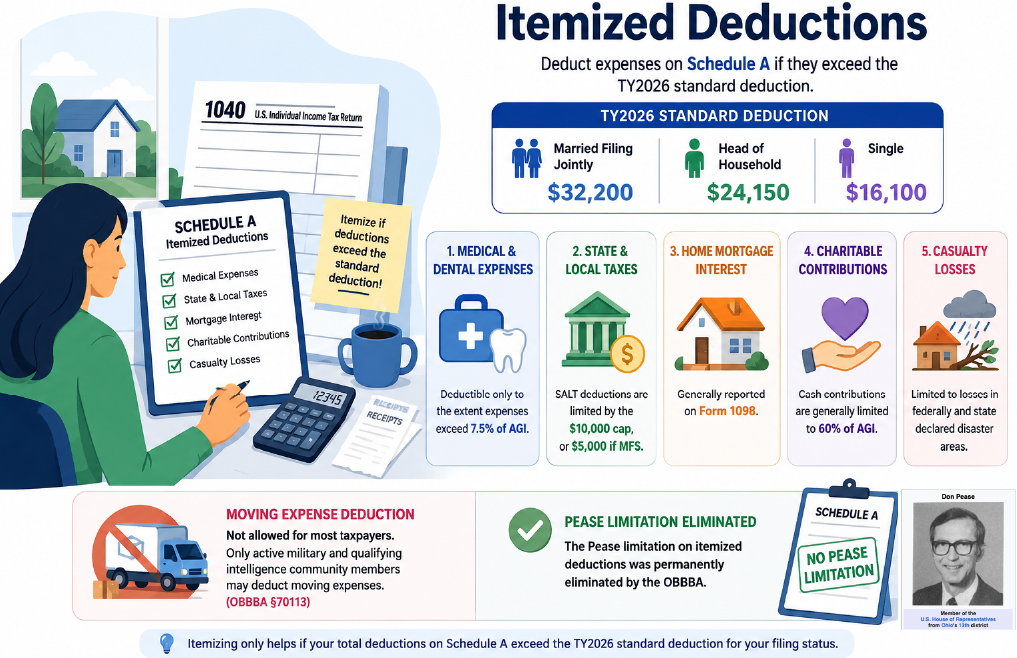
Medical and dental expenses are deductible on Schedule A only to the extent they exceed 7.5% of AGI.
TY2026 Rule
For TY2026, the threshold remains 7.5% under IRC §213.
OBBBA Update
The OBBBA permanently set the medical expense floor at 7.5% of AGI, eliminating the prior uncertainty between the 7.5% and 10% thresholds.
Eligible Medical Expenses Include:
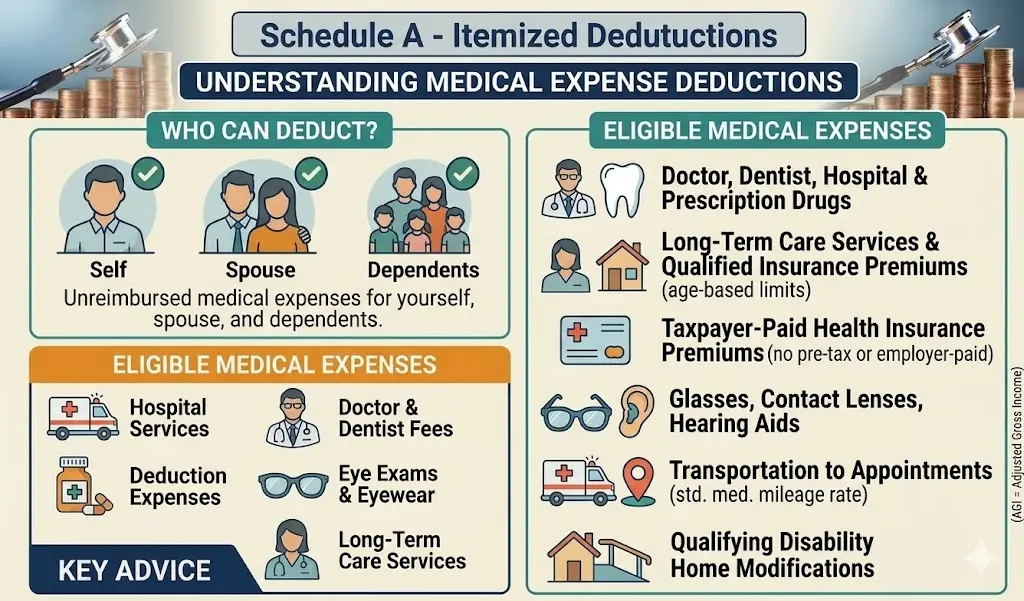
Not deductible as medical:
Generally Not Deductible
Cosmetic Surgery
Generally not deductible unless correcting a deformity, injury, or qualifying medical condition.
Gym Memberships
Health club dues and general fitness memberships are usually personal expenses.
Diet Foods
Special foods or diet products are generally not deductible when used for general health or weight control.
Non-Prescription Drugs
Over-the-counter drugs are generally not deductible, except insulin.
Practitioner Reminder
Do not include personal, cosmetic, fitness, or general wellness expenses as deductible medical expenses unless a specific tax rule allows the deduction.
2.11.2 — State and Local Tax (SALT) Deduction
Taxpayers may deduct state and local taxes on Schedule A, but the total SALT deduction is capped at $10,000 per return ($5,000 for MFS) under the TCJA. This cap was made permanent by the OBBBA for TY2026 and beyond. Deductible SALT items include:
Not deductible: federal income taxes, estate and inheritance taxes, most foreign taxes (addressed separately), homeowner association fees, or special assessments for local improvements.
Sales tax election:
Sales tax election: Taxpayers in states with no income tax (e.g., Florida, Texas, Nevada) may elect to deduct state and local general sales taxes instead of income taxes. The IRS provides an optional sales tax table — actual receipts are not required if using the table.
2.11.3 — Home Mortgage Interest
Home mortgage interest is deductible on Schedule A for interest paid on acquisition debt secured by a qualified residence (primary home or one secondary home). Form 1098, Mortgage Interest Statement, reports the interest paid.
2.11.4 — Charitable Contributions
2.11.4.1 — 60% AGI Limit for Cash Contributions
Cash contributions to qualifying public charities, governmental units, and certain private foundations are deductible up to 60% of AGI. Contributions of appreciated property (e.g., stocks, real estate) are generally limited to 30% of AGI (or 20% for certain private foundations). Excess contributions can be carried forward for up to 5 years.
2.11.4.2 — $250 Written Acknowledgment Requirement
For any single contribution of $250 or more — whether cash or property — the taxpayer must obtain a contemporaneous written acknowledgment from the donee organization. “Contemporaneous” means received by the earlier of the return due date or when the return is filed.
The acknowledgment must state:
No receipt = no deduction: For contributions of $250 or more, a bank statement, credit card statement, or cancelled check is NOT sufficient. A written acknowledgment from the organization is required. Without it, the deduction is disallowed even if the payment is proven.

2.11.3 — Home Mortgage Interest
Since the TCJA 2017, personal casualty losses are deductible only if attributable to a federally declared disaster. The OBBBA extended this treatment and also provides that losses from state-declared disaster areas may qualify beginning TY2026, even if the President has not made a federal disaster declaration — this is a significant expansion that practitioners must track.
Casualty Loss Calculation:

Deduction for Non-Itemizers (Disaster Loss)
Standard Deduction Plus Qualified Disaster Loss
Special Provision
A qualifying disaster area casualty loss may be deducted even when the taxpayer claims the standard deduction.
Added to Standard Deduction
The qualified disaster loss is added to the taxpayer’s standard deduction instead of requiring full itemization.
Not Full Itemizing
The taxpayer reports the loss on Schedule A, but does not have to itemize all other deductions.
Practitioner Reminder
This rule preserves the standard deduction while allowing a qualifying disaster loss benefit. Confirm that the loss occurred in a qualifying disaster area before applying the special treatment.
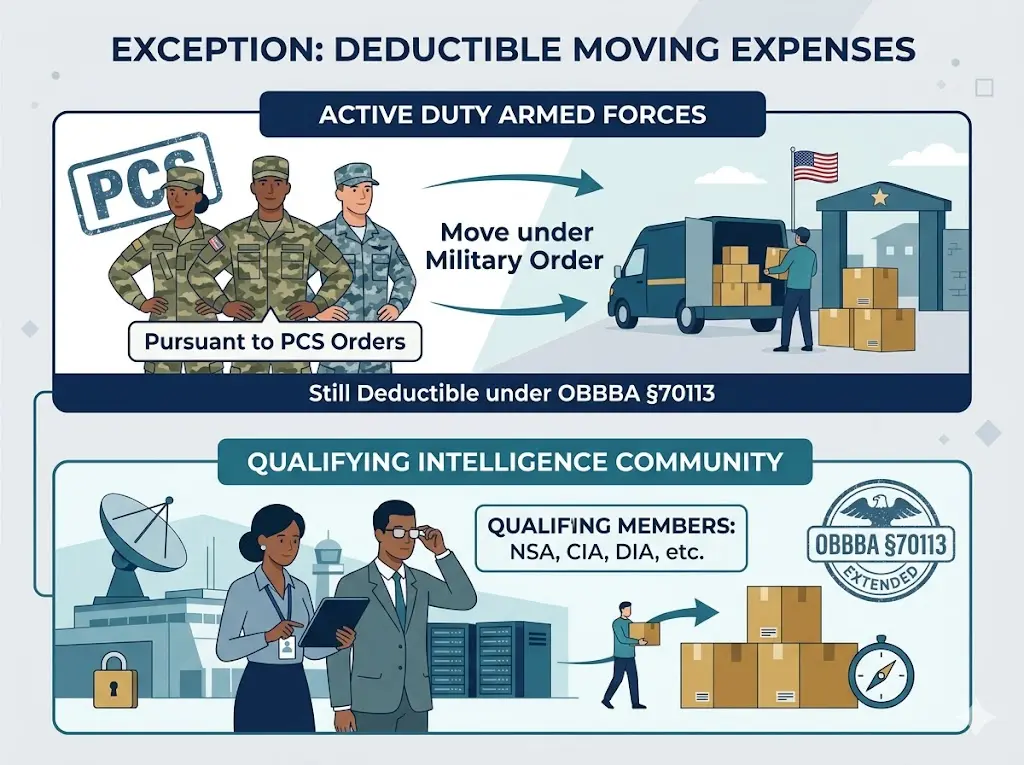
2.11.6 — Moving Expense Deduction (OBBBA §70113)

2.11.7 — Recordkeeping and Documentation
All itemized deductions require supporting documentation. The IRS may disallow any deduction for which adequate records cannot be produced. Key documentation requirements:
|
Deduction Category |
Required Documentation |
|---|---|
|
Medical expenses |
Receipts, explanation of benefits (EOB), pharmacy statements; Form 1099-LTC for LTC benefits received |
|
State and local taxes |
Tax bills, receipts, tax withholding statements (W-2 Box 17); vehicle registration receipts showing value-based tax |
|
Mortgage interest |
Form 1098 from lender; closing statement for points paid at closing |
|
Charitable cash (<$250) |
 Bank record, receipt, or written communication from charity showing name, date, and amount |
|
Charitable cash (≥$250) |
Contemporaneous written acknowledgment from organization |
|
Non-cash charitable |
|
|
Casualty losses |
Proof of federal/state disaster designation; photos; insurance claims; repair estimates; FMV documentation |
Worked Example 1 — Medical Expense Floor
Medical Expense Floor
Filing Status
Marcus and Linda file MFJ for TY2026.
Adjusted Gross Income
Their TY2026 AGI is $120,000.
Medical Expenses
Unreimbursed medical expenses total $14,500.
7.5% AGI Floor
7.5% × $120,000 = $9,000
Deductible Medical Amount
$14,500 − $9,000 = $5,500 deductible on Schedule A.
Key Medical Expense Rule
Only the portion of unreimbursed medical expenses exceeding 7.5% of AGI is deductible on Schedule A.
Worked Example 2 — SALT Cap Applied
SALT Deduction Cap
State Income Tax
The Johnsons paid $8,400 in state income tax during 2026.
Real Property Tax
They also paid $6,200 in real property taxes.
Total SALT Paid
Total state and local taxes paid = $14,600.
SALT Limitation
Even though the Johnsons paid $14,600, the federal SALT deduction is capped at $10,000.
Deduction Allowed
The Johnsons deduct $10,000 on Schedule A. The remaining $4,600 provides no federal tax benefit.
MFS Limitation
If the Johnsons filed Married Filing Separately, each spouse would be limited to a maximum SALT deduction of $5,000.
Worked Example 3 — Charitable Acknowledgment Failure
Charitable Contribution Documentation Failure
Donation Made
Donna donated $500 cash to her church during 2026.
Documentation She Has
Donna retained a cancelled check showing the payment cleared her bank account.
Missing Requirement
She did not obtain a contemporaneous written acknowledgment from the church.
Deduction Disallowed
The $500 deduction is disallowed. A cancelled check alone is insufficient for a single contribution of $250 or more.
Required Documentation
Donna needed a contemporaneous written acknowledgment from the church before claiming the deduction.
Practitioner Tip
Advise clients to request charitable acknowledgment letters before year-end. Many churches issue them in January, which may be too late if the taxpayer files early.
Worked Example 4 — Disaster Casualty Loss, Non-Itemizer
Qualified Disaster Loss for a Non-Itemizer
Filing Status
Paul files as Single for TY2026 and normally claims the standard deduction.
Disaster Damage
Paul sustained $28,000 in uninsured property damage from a federally declared disaster.
Adjusted Gross Income
Paul’s AGI is $65,000.
Casualty Loss Calculation
$28,000 − $100 = $27,900
$27,900 − 10% of AGI ($6,500) = $21,400 deductible casualty loss.
Standard Deduction Plus Disaster Loss
Standard deduction: $16,100
Plus deductible disaster loss: $21,400
Total deduction: $37,500
Non-Itemizer Disaster Rule
Paul does not have to fully itemize deductions to claim the qualified disaster loss. The deductible casualty amount is added directly to his standard deduction.
Worked Example 5 — Moving Expense Disallowed
Civilian Moving Expense Reimbursement
Job Relocation
Jennifer relocated from Texas to California for a new job in 2026.
Employer Reimbursement
Her employer reimbursed $9,000 of moving expenses.
Civilian Employee
Jennifer is a civilian employee, so she does not qualify for the remaining moving expense benefits.
Taxable Wages
The $9,000 reimbursement is taxable wages and should appear in Box 1 of Jennifer’s Form W-2.
No Moving Expense Deduction
Jennifer cannot deduct moving expenses on her TY2026 return because the deduction and exclusion do not apply to civilian employees.
OBBBA §70113 Rule
Only active military members and qualifying intelligence community members retain moving expense deduction and exclusion benefits. Civilian employee reimbursements are taxable wages.